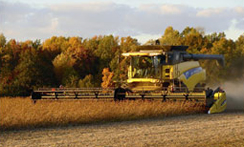
The header is where the crop meets the machine, and it is the component most likely to be costing you grain without anyone noticing. It is also, pound for pound, the cheapest place to improve a harvest operation, because a header change is a fraction of a combine change.
Draper or auger
The short version: drapers feed more evenly, auger headers cost less and are more tolerant of rough ground and heavy tough material.
The longer version is about feeding. A draper delivers a steady, thin mat of material into the feederhouse, which is exactly what the threshing system wants. An auger header gathers material and pushes it in, which in a heavy crop produces a less even flow.
Even feeding is worth real capacity. If you are regularly plugging or regularly backing off ground speed because the machine is surging, the header may be the constraint rather than the combine.
Where auger headers still make sense: tough, wet, heavy material that a draper struggles to move, rougher ground, and operations where the cost difference matters more than the last few percent of capacity.
Flex, rigid, or flex draper
In this part of Saskatchewan, with the crops most people are growing, true flex headers matter less than they do further south where soybeans dominate. Cutting height on cereals and canola is usually well clear of the ground.
Where flex earns its place here is on uneven fields and in any crop where you are cutting low, and the flex draper combines even feeding with ground following for operations that need both.
Width, and the honest limit
A wider header only helps if the combine can thresh what it delivers. Putting a header on the front that outruns the separator produces a machine that either plugs or runs slower per acre than the narrower setup did, and an owner who is confused about why.
Match the header to the machine, not to the neighbour's.
The other limit is transport. A header that is awkward to move between fields costs time on every move, and in an operation with scattered land that adds up quickly.
What matters specifically for canola
If you are straight cutting canola, the header is the decision, more than the combine:
- Extended cutterbar gives the crop room to fall onto the table rather than over the front, which is where a surprising amount of canola goes
- Reel position and speed adjustment range, because canola needs gentle handling and a reel running too fast shatters pods at the bar
- Vertical knives for tangled or lodged crop, which is the difference between a difficult field and an impossible one
- Crop lifters where the crop is down
Pickup headers for swathed crop
If you are swathing, the pickup is doing work that affects everything downstream. Worn pickup teeth, wrong pickup speed relative to ground speed, and poor swath feeding all cost grain before the material reaches the machine.
Pickup speed should be matched so the swath is lifted rather than pushed or snatched. Too fast throws material, too slow bunches it.
Buying used
Headers hold up well and a good used header is often better value than a new one. What to look for:
- Draper belts, which are a known replacement cost and worth pricing before you buy
- Knife drive condition
- Reel tines and reel arms, for straightness
- Whether the adapter matches your combine, since a cheap header plus an expensive adapter is not a cheap header
Come and look at what we have
We carry headers alongside the rest of our equipment, and our teams can tell you what is actually working on machines like yours in this area.
Browse equipment or talk to our team.


